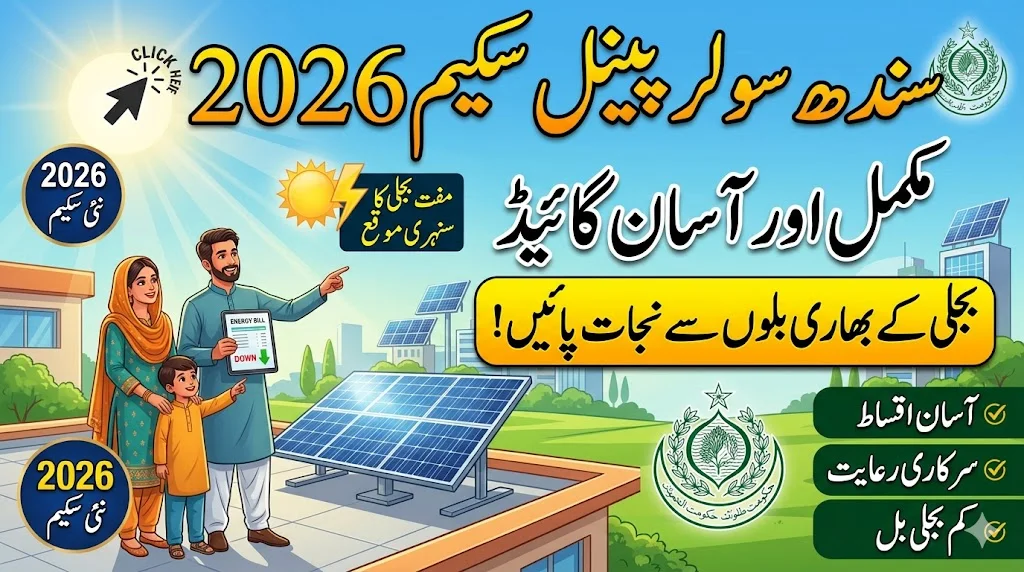
Sindh Solar Panel Installation Scheme 2026 Complete Guide to Free And Subsidized Solar Energy
Electricity costs in Pakistan continue to rise, while load shedding remains a serious problem—especially in rural and semi-urban areas of Sindh. In response, the government is preparing the Sindh Solar Panel Installation Scheme 2026, a large-scale initiative designed to provide affordable, reliable, and clean solar energy to low-income households.
This program is part of a broader energy transition strategy focused on reducing electricity poverty and expanding renewable energy access across the province.

What Is the Sindh Solar Panel Scheme 2026?
The Sindh Solar Panel Scheme 2026 is a government-supported solar energy initiative aimed at helping households shift from expensive grid electricity to solar power.
The program focuses on:
- Reducing electricity bills for poor families
- Providing backup electricity in load-shedding areas
- Promoting renewable and clean energy
- Expanding energy access in rural Sindh
It is closely linked with the Sindh Solar Energy Project (SSEP), a major renewable energy program supported by international development partners.
Sindh Solar Energy Project (SSEP) Overview
The Benazir Income Support Programme (BISP)-linked welfare ecosystem and provincial energy reforms align with broader development efforts, including the Sindh Solar Energy Project (SSEP) supported by the World Bank.
Key Highlights of SSEP
- Large-scale solar expansion across Sindh
- Around $100 million investment support
- Development of utility-scale solar plants
- Solar electrification for public institutions
- Household solar system distribution
Major Project Goals
- Install solar infrastructure in underserved regions
- Improve electricity supply reliability
- Reduce dependence on fossil fuels
- Support climate-friendly development
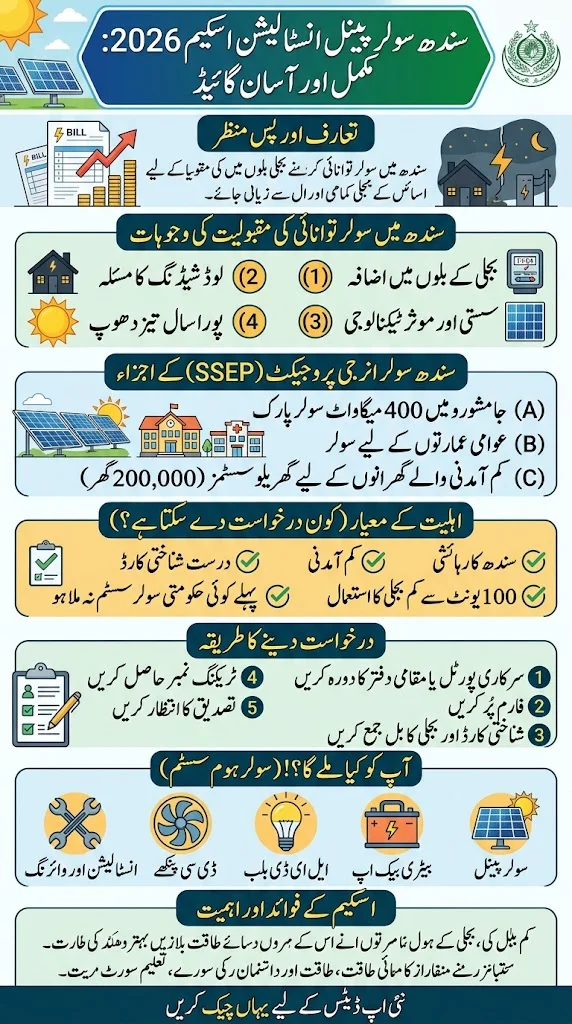
Main Components of the Solar Scheme
1. Large Solar Power Projects
Includes utility-scale solar parks such as a 400 MW solar plant in Jamshoro, which will add significant clean energy to the grid.
2. Public Sector Solar Systems
Solar installations in:
- Schools
- Hospitals
- Government buildings
- Public service centers
3. Household Solar Systems
The most important part of the scheme is direct support for families through:
- Solar panels
- Battery backup systems
- LED lights
- DC fans
- Installation and wiring support
Who Can Apply? (Eligibility Criteria)
The scheme mainly targets low-income households that face high electricity costs or lack reliable power.
You may qualify if you:
- Are a resident of Sindh
- Have a valid CNIC
- Use low electricity consumption (usually under 100 units/month)
- Belong to a low-income or vulnerable household
- Have not received a government solar system before
How to Apply for Solar Panel Scheme 2026
The application process is expected to be simple and accessible for rural communities.
Step-by-Step Process
- Visit the official government portal or local registration center
- Fill out the application form
- Provide required documents:
- CNIC copy
- Electricity bill (if available)
- Contact number
- Submit the form for verification
- Wait for eligibility confirmation and approval
In some cases, local officials or Union Councils may verify household data before final selection.
What You Will Receive
Eligible households will receive a Solar Home Energy System, which typically includes:
- Solar panels for electricity generation
- Battery for night-time backup
- LED bulbs for lighting
- DC fans for basic cooling
- Installation and safety wiring
These systems are designed to support essential daily needs like lighting, charging, and small appliances.
Key Benefits of the Scheme
Financial Benefits
- Significant reduction in electricity bills
- No fuel cost dependency
Lifestyle Improvements
- Reliable electricity during load shedding
- Better study conditions for children
- Improved daily comfort in rural homes
Environmental Impact
- Reduced carbon emissions
- Clean and renewable energy usage
- Less pressure on national grid
Why This Scheme Matters for Sindh
Sindh faces some of the highest electricity challenges in the country. This scheme is important because it:
- Supports energy-deprived communities
- Encourages long-term renewable adoption
- Reduces poverty-linked energy stress
- Strengthens rural development
It is also part of Pakistan’s long-term transition toward sustainable energy systems.
FAQs – Sindh Solar Panel Scheme 2026
1. What is the main purpose of this scheme?
To provide affordable solar energy systems to low-income households in Sindh and reduce electricity dependence.
2. Is the solar system free?
Most systems are expected to be fully or partially subsidized depending on eligibility and government policy.
3. Who can apply?
Low-income residents of Sindh with valid CNIC and low electricity usage can apply.
4. What items are included in the solar kit?
Solar panels, battery backup, LED lights, DC fans, and installation support.
5. How will selection be done?
Through verification of CNIC, household data, and electricity consumption records.
6. When will registration start?
Applications are expected to open in phases during the 2026 rollout after official announcements.
7. How many families will benefit?
The project aims to support approximately 200,000 households across Sindh.
Final Summary
The Sindh Solar Panel Installation Scheme 2026 is a major step toward affordable and sustainable energy in Pakistan. It aims to reduce electricity costs, improve living standards, and promote clean energy adoption across Sindh.
For eligible households, this scheme represents a long-term solution to rising electricity prices and load shedding challenges—offering stability, savings, and energy independence.